
Institutionalizing Real-time Health Monitoring in Ethiopia
Health program leaders make life-altering decisions every day: the number...
Insights
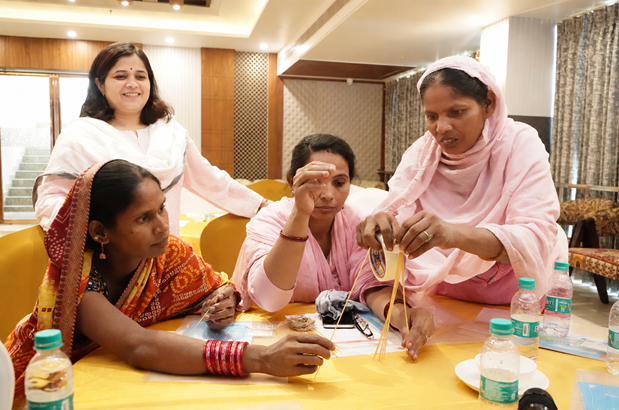
Caregivers and health workers engaged in co-creation workshop activities. Credit: JSI
Authored By:
India has made remarkable progress in reducing the number of zero-dose children (that is, children who have not received even their first dose of the basic diphtheria, tetanus and pertussis vaccine). As the country moves closer to reaching every child, the challenge is increasingly about reaching those who remain unreached. Doing so requires solutions that are responsive to local realities, because the reasons children are missed can vary considerably across communities and households. In this context, we are sharing our experience of applying a “Learning by Doing” approach in urban areas of Bihar and Uttar Pradesh, an approach that combined human-centred design with continuous learning to understand local barriers, co-create potential solutions, and adapt them as implementation unfolded.
We mapped out potential solutions by co-creating with caregivers of zero-dose children, frontline health workers, and government stakeholders. These interventions were then tested, refined, and adapted based on ongoing implementation experiences and feedback. Our approach was structured around three phases: Define, Design, and Deliver (3D).
In the heart of Ethiopia’s Oromia Region, a quiet transformation...

Pregnancy-related deaths in the U.S. number about 650 to 700...