Integrating Private Sector Data to Map Ethiopia’s Health Landscape
story

Najmudin Warkisho, Director of Quality Control and Strategy Department at Amin General Hospital.
For many private health facilities in Ethiopia, the Health Management Information System (HMIS) was viewed as a regulatory burden. Despite the private sector’s growing role in the market, its performance in health data reporting remained low due to misunderstandings of the technical requirements and a historical lack of oversight. For the Ministry of Health, this meant it was impossible to gain a complete picture of national health.
Through the Data Use Partnership (DUP) project, JSI collaborated with the Ministry of Health to develop a national HMIS implementation guideline specifically tailored for private sector use. In February 2025, JSI partnered with the Ethiopian Healthcare Federation (EHF) – a local umbrella organization for the private health care sector – to pilot practical, scalable approaches across 60 facilities in four regions.
This collaboration gathered a pool of mentors who delivered on-the-job training to private facility leaders and HMIS focal persons, ensuring comprehension of HMIS. JSI empowered EHF with funding, grant management training, and mentorship. Through this partnership, hospitals like Amin General in Addis Ababa are proving that high-quality data is a strategic asset that optimizes client health outcomes, streamlines clinical workflows, and secures the bottom line.
The high-volume Amin General Hospital in Addis Ababa, for example, once struggled with data quality. By establishing a monthly performance monitoring team, the hospital leadership reviews data as a standard practice. With JSI’s support, they also integrated data visualization dashboards into their electronic medical record system.
A high cesarean section rate of 46, compared to only 12 vaginal deliveries, was immediately identified upon first data review. Further analysis indicated that the trend was driven by clients’ fear of labor pain and physicians’ tendency to encourage cesarean births. To address this, the hospital implemented an awareness campaign for both physicians and pregnant women, alongside the introduction of epidural injections for labor pain relief. This approach successfully provided women with informed delivery choices, resulting in a shift toward vaginal deliveries, with 30 recorded by March 2026.
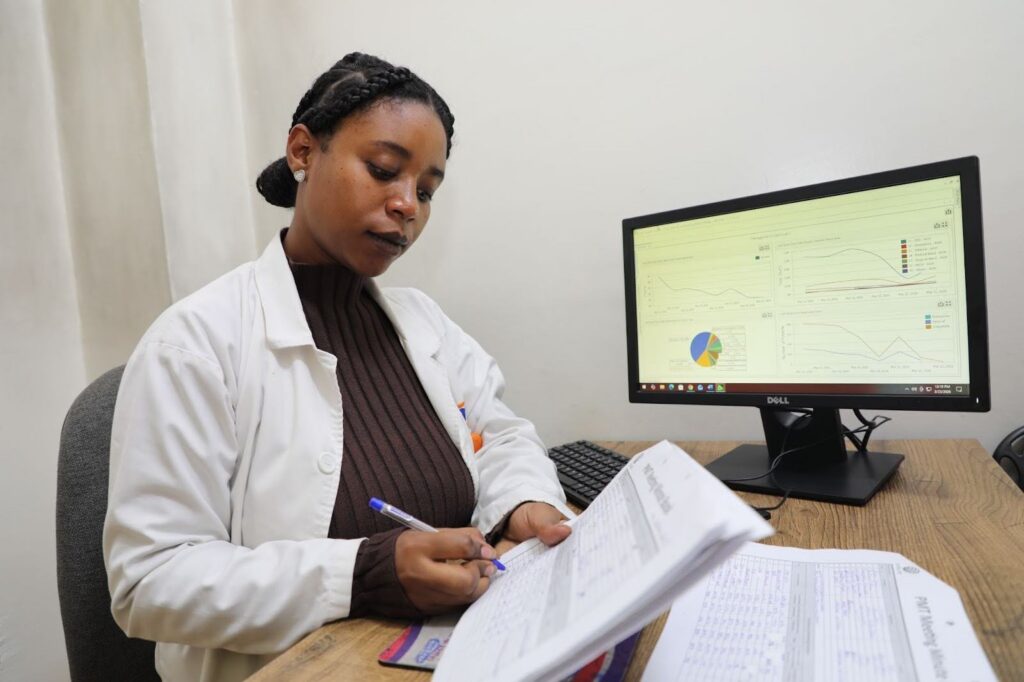
Malefiya Mulat, HMIS Officer at Amin General Hospital.
Improved data use also impacted operational efficiency in Amin General Hospital. An initial analysis revealed a low bed occupancy rate of just 46%, signaling missed opportunities to optimize patient care. In response, the hospital implemented an admission and referral protocol, which provides medical teams with clear guidelines for patient admission and discharge. The hospital also developed partnerships with nearby health facilities to alleviate their patient overload. As a result, bed occupancy increased to 60% by March 2026.
We did not expect data use to have such a profound effect. Being serious about information helps an organization become more effective with its services and efficient with its resources,” HMIS Officer Malefiya Mulat commented.
Convincing the private sector to participate requires helping them understand how they will benefit from improved data collection and reporting, and demonstrating the value of enhanced data use and data-informed decision-making.
Acknowledging the successful pilot tests of this initiative, the Ministry of Health is considering scaling it up to reach more private health care facilities. The expansion aims to equip these facilities with the necessary skills and practices for effective implementation of the HMIS, while building a holistic approach to data use, enabling better health outcomes for all.
We strive to build lasting relationships to produce better health and education outcomes for all.