Social and Behavior Change at the Heart of People-Centered Care
story

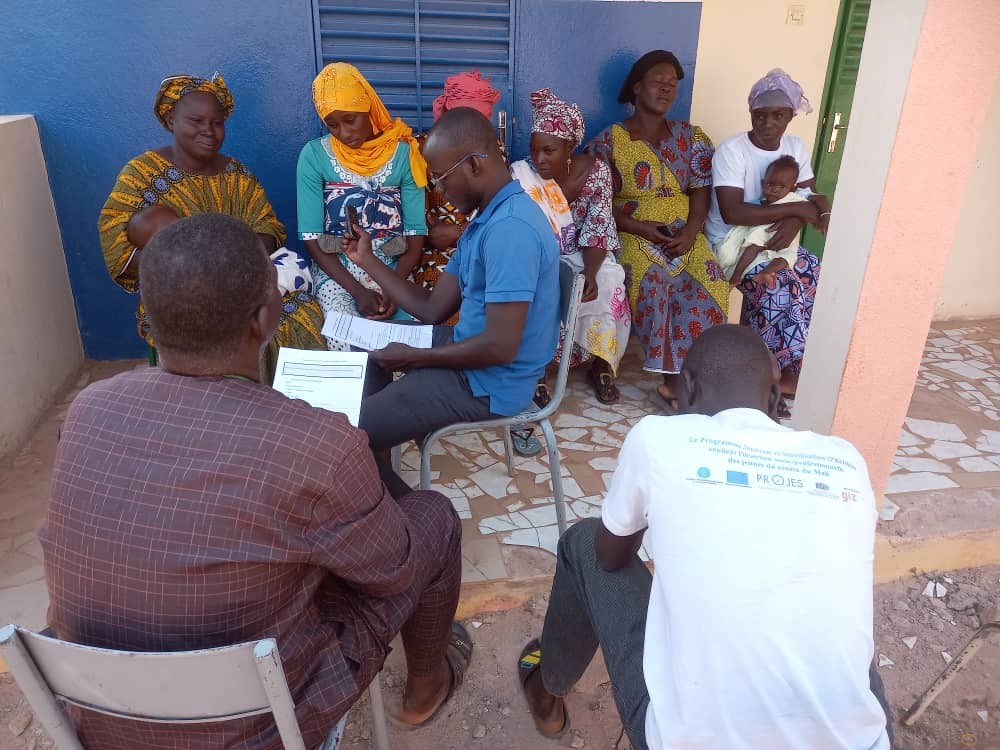
A Mali Learning Hub team member conducts a focus group with mothers of young children.
Public health outcomes are shaped by more than policies or commodities; they are driven by human behavior. Success depends on caregivers seeking services, individuals maintaining healthy practices, providers following protocols and strengthening patient interactions, managers using representative data, and communities trusting health systems. When these behaviors are not present, even well-funded programs underperform. Social and behavior change (SBC) comprises practical, evidence-based approaches that help health systems influence these behaviors at scale. It addresses the real-world factors that determine whether services are used, guidelines are followed, and investments translate into measurable impact.
Despite its importance, SBC is rarely funded as a core system function. It has traditionally been confined to short-term communication or campaign activities, often activated during emergencies and housed within narrow “Information, Education, and Communication (IEC),” behavior change communication, or community outreach budget lines. Although the framing of SBC approaches has expanded to include community engagement, social mobilization, and risk communication and community engagement, institutionalizing SBC investments remains challenging. While recognition of SBC’s role in achieving health outcomes has grown, the gap between strategy and financing leaves countries with strong technical plans but insufficient capacity and resources for implementation.
The path forward requires shifting from isolated SBC activities to integrating SBC across all health system pillars: governance and leadership, workforce development, service delivery and design, data systems, and financing. A major barrier is the absence of standardized SBC budget codes, consolidated costing guidance, and accountability mechanisms within health financing processes. These gaps limit ministries’ ability to embed SBC in public financial management systems and secure predictable domestic financing. As donor funding declines and health disparities widen in many settings, strengthening countries’ capacity to cost and finance SBC is increasingly urgent for system resilience and sustained impact. SBC is not a vertical program or standalone discipline; it is a cross-cutting system function that supports immunization, primary health care, supply chains, digital health, workforce performance, and emergency preparedness and response. Wherever health outcomes depend on human decision-making, SBC is relevant and should be financed accordingly.
Against this backdrop, the Africa Centres for Disease Control and Prevention (Africa CDC) launched a multicountry initiative to strengthen SBC costing and financing capacity across member states. As part of this effort, the Continental SBC Costing and Financing Workshop, held in Lilongwe, Malawi, in November 2025, convened Ministries of Health and Finance from Malawi, Burundi, Uganda, and The Gambia to co-develop a standardized costing framework, budget coding taxonomy, and practical tools to institutionalize SBC within national planning and budgeting cycles.
JSI joined Africa CDC and UNICEF to co-facilitate the workshop. JSI’s participation reflects our work in SBC institutionalization and our expertise in immunization costing and measurement, including the Operational Guidance: Estimating the Costs of Interventions to Reach Zero-Dose Children, developed through the Gavi-funded Zero-Dose Learning Hub. This collaboration applied that expertise at the intersection of public health planning and financial sustainability.
Workshop participants emphasized the urgent need for distinct budget codes to replace generic categories that obscure how funds are allocated and spent. Without explicit costing and coding, SBC activities are often absorbed into vague budget lines, making them vulnerable to cuts and limiting realistic planning. These financing gaps translate into under-resourced community engagement, inconsistent provider training, and limited use of behavioral data, directly undermining service uptake, quality of care, and health outcomes.
To address this, the workshop applied an ingredients-based costing tool developed by Africa CDC to help participants define specific costable components. This methodology requires countries to disaggregate interventions into granular cost objects, units, and volumes, shifting budgets from broad estimates to precise, evidence-based inputs. By identifying the concrete ingredients required for effective SBC, ministries of health can present transparent, defensible budgets to ministries of finance and advocate for sustained domestic investment. A key technical output was the recommendation to create new SBC subcodes aligned with national charts of accounts, reducing reliance on miscellaneous IEC categories. This level of specificity enables governments to articulate what it takes for communities to adopt healthier behaviors and for providers to deliver consistent, high-quality care, while meeting finance ministries’ requirements for clear cost drivers and realistic assumptions.
Participants shared a common understanding that SBC must be integrated into health systems and sustained beyond short-term projects and emergency responses. Institutionalized SBC enables governments to move from ad hoc, donor-driven spending to predictable, domestically financed investments that improve service uptake and efficiency. From a universal health coverage perspective, SBC addresses demand-side barriers—such as trust, social norms, and access constraints—that limit service use. From a health security perspective, it strengthens the behavioral capacities needed for preparedness, risk communication, and rapid response.
To support this shift, the workshop introduced the SBC Institutionalization Assessment Tool, a practical scorecard designed to position SBC as a core, costed function of the health system. The tool allows countries to evaluate progress across five pillars:
Together, these domains provide a structured framework for diagnosing gaps, prioritizing reforms, and tracking progress toward nationally owned SBC implementation.
The workshop highlighted the need to move from episodic SBC campaigns to routine, system-integrated practice. When treated as a time-bound activity, SBC remains disconnected from the daily behaviors that determine service quality and sustainability. A systems-based approach positions SBC as an enabler of performance by using behavioral data to inform supply chain operations, applying human-centered design to improve client experience, and maintaining funded, responsive community feedback mechanisms, such as grievance mechanisms or social listening systems. Integrating SBC objectives into service delivery strategies ensures that SBC informs design and execution rather than functioning as an afterthought.
During the workshop, country teams applied the costing tool to identify the activities and inputs required for routine SBC implementation, mapping national SBC actions and assigning realistic unit costs and volumes. In the weeks that followed, Africa CDC and UNICEF provided targeted in-country support to deepen understanding of SBC as a system-wide function, reinforce the importance of explicit costing, and help ministries of health and finance complete the tool. Countries refined cost assumptions for both existing activities and those needed to institutionalize SBC as a fully financed component of the health system.
Public health investments fail not because tools or services are absent, but because systems depend on people—providers, managers, and communities—changing what they do every day. Recognizing, planning for, and financing this reality is essential to sustained public health impact, universal health coverage, and health security. JSI remains committed to partnering with governments and funders to move beyond fragmented projects toward health systems in which social and behavior change is institutionalized as a core function, planned, costed, financed, and monitored alongside every other essential component of service delivery.
We strive to build lasting relationships to produce better health and education outcomes for all.