Built to Last: Why Maternal Health Innovations Must Be Integrated by Design
viewpoint

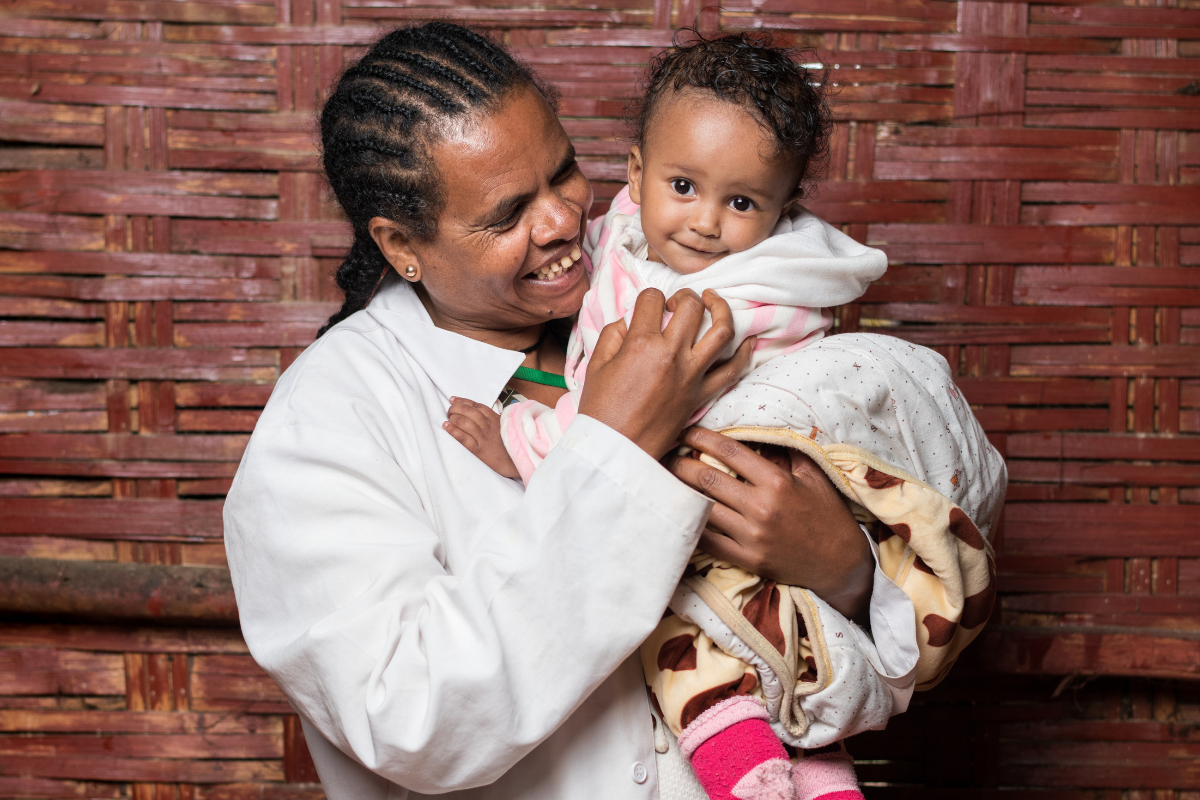
A midwife holds one of her patients after a check-up. Photo: Robin Hammond for JSI
While several countries have successfully moved the needle on national health outcomes through sustained system-wide reforms, much of the global health landscape remains characterized by fragmented, small-scale pilots. These initiatives often prove a concept but struggle to achieve lasting impact because they are treated as ‘add-ons’ rather than integral components of the national health system.
To achieve the bold maternal and child health goals of the global 2030 Agenda for Sustainable Development, we must treat innovation not as a stand-alone intervention but rather as a health systems strengthening strategy to be institutionalized. At the heart of every health system is the health worker. Whether in a remote village or a primary health center, the success of any new tool or approach depends entirely on the person using it. By aligning innovations within routine workflows and centering our approach on an equipped, motivated, and empowered health workforce, we transform innovation from a temporary experiment into a permanent feature of a resilient health system.
We define integration by design as a deliberate process of embedding innovation from inception into the existing national health systems and routine service delivery. Horizontal scale-up—reaching more people and places—is only sustainable if it is supported by institutionalization (vertical scale-up) into national policies, regulatory frameworks, and budgets. Partnerships with ministries of health must be collaborative and bidirectional; ministries provide regulatory and policy leadership to steer strategic reforms, while we provide the real-time implementation evidence needed to clear operational and systemic obstacles. This approach ensures that systems-strengthening strategies, from diagnostics to digital learning, become institutionalized core features of a resilient health system.
Successful scale-up requires us to begin with the end in mind. Before introducing any tool, we ask: Does this lighten the end-user’s workload? Can local systems support it long-term? Will it improve health outcomes? If an innovation is difficult to integrate into a daily workflow or incompatible with national digital architecture, it is not a solution—it is a burden that will never be sustained. Institutionalization also requires feedback loops and adaptive learning. We invest in regular data review to manage “field friction” in real-time, and our cost-effective, high-impact solutions address the highest-burden conditions contributing to the major causes of maternal and child death.
Diagnostic delays caused by significant shortages of radiology professionals are a major factor in maternal and perinatal mortality. We supported a strategic task-shifting effort that equipped mid-level providers (midwives and nurses) in Ethiopia to perform point-of-care ultrasound (POCUS) at the primary care level.
Impact: Providers identified obstetric and fetal abnormalities in 13% of the nearly 13,000 women screened, achieving a 98% referral success rate for confirmatory diagnosis and further care. These interventions averted significant morbidity and mortality, saving an estimated 1,970 mothers per 100,000 live births and 10 neonates per 1,000 live births.
Traditional face-to-face training is resource-intensive and disruptive, pulling health workers away from facilities when they are needed most. We addressed this in Ethiopia by institutionalizing a blended learning model. We embedded the model into a continuing professional development system and a national e-learning platform, which JSI helped develop. By combining flexible, self-paced digital modules with structured, skills-based face-to-face mentorship, we ensured health workers could effectively integrate learning opportunities into their work.
Impact: Knowledge scores rose from 65% to 82%, and care quality improved significantly by 11% and 26%, for antenatal care and family planning, respectively. Training costs were reduced by 27% ($97.30 per provider). Importantly, remote learning permits health care workers to stay up-to-date on rapidly evolving clinical guidelines even in the face of climate constraints and insecurity.
To achieve the 2030 Agenda, we must move beyond proving concepts. Only by co-designing with national partners, planning for scale at the outset, and embedding innovations into the fabric of existing systems can we ensure high-quality, person-centered care for every mother and child.
We strive to build lasting relationships to produce better health and education outcomes for all.