Rural Lifelines, Part 1: Supporting the Health Care Workforce
viewpoint

Rural health is at a pivotal moment. Rural hospital closures outpaced openings in the U.S between 2017 and 2024, with many rural hospitals losing specialty care service offerings. Many rural facilities with declining patient volumes and negative financial margins lack the resources to hire and retain the array of health providers needed to meet a high standard of care, leaving fewer providers to handle more cases and eroding trust and access to care among those who need it most.
“We’re witnessing mounting risk for rural community hospitals,” says Alec McKinney, a JSI U.S. Health Services Division Principal specializing in health system assessment, analysis, and technical assistance at the state and local level in Massachusetts and other states. McKinney continues, “In maternal and child health, many rural community hospitals face declining patient volumes and rising costs and are not able to justify hiring multiple obstetrician-gynecologists to strengthen their maternity services. This leaves providers feeling isolated and diminishes patient trust in the quality of care, or the maternity ward may close altogether. It’s vital that we push back on these trends. Patients experience better outcomes when they can access care in their community.”
JSI’s work across the United States tells us that rural maternal health isn’t just an issue in Massachusetts, nor is it only maternal health that is at risk. States must look beyond gaps in service and explore how to support, sustain, and strengthen health systems in rural communities.
With over three decades of experience in community-based care, JSI has identified the essential strategies needed to strengthen rural health systems, support providers, and prioritize patients. We are exploring these pillars in a new article series, “Building a Strong Health System for Rural Communities”. In this first article, we examine how supporting health care providers enables high-quality access to care in rural areas.
For many rural clinicians and hospital leaders, professional isolation and lack of peer-to-peer learning are significant drawbacks. In rural areas, technology can support workforce recruitment and retention efforts, bridge geographic distance, and link providers with the support they need. For example, JSI supports the Wyoming Department of Health in connecting medical providers who treat youth with mental health care needs with training, resources, and teleconsultation. Providers can consult virtually with other child and adolescent psychiatrists on challenging cases. Providers reported that this access alleviates stress and increases their confidence in serving their pediatric patients and their families.
JSI’s work on the Treating Addiction in Rural Areas ECHO (1) provides another model of connecting providers by building an interdisciplinary professional community. The project virtually convenes two cohorts of behavioral health and addiction treatment, recovery, and peer support providers serving rural communities in Maine, New Hampshire, and Vermont. The project expands evidence-based capacity, knowledge, and skills, shifting care towards patient-driven treatment plans. “People join to train on standards of care, but we’ve noticed that they stay because of the community they become a part of, with 95% of participants indicating that participation reduced their professional isolation,” says JSI Senior Associate and ECHO Project Director Adelaide Murray. These connections allow rural providers to offer a higher level of care than they could provide on their own, filling the gaps when other expertise is not available.
Another way to support the health workforce is to stabilize the facility environment. Financial stress and staff turnover undermine workforce morale. But facilities have options.
There is an increasing emphasis nationally on reforming how rural hospitals and other outpatient service providers or independent clinicians are paid. These efforts reflect structural instability in rural health care markets, persistent facility closures, and a recognition that traditional fee-for-service models don’t work well in low-volume settings. New payment policies are focusing on global budgeting, increasing facility payments, and cost-based reimbursement. Together, these efforts increase the predictability of revenues even when volume is low, allowing providers to invest in workforce strengthening, essential technologies, operational efficiency, and other critical facility improvements. Additionally, facilities can look at braiding funding from several sources to cover gaps in discrete funding streams.
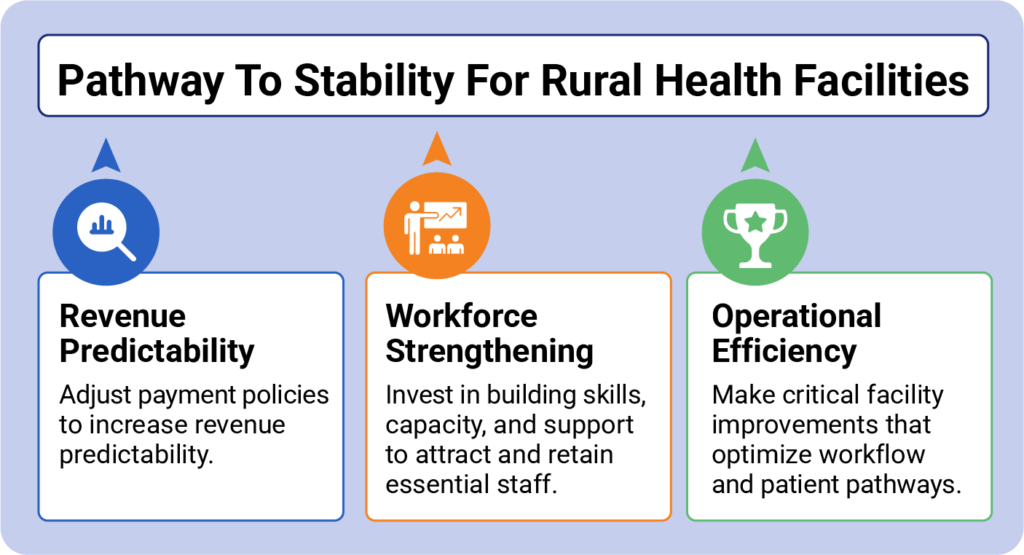
Rural facilities also sometimes struggle to recruit or retain specialty providers that their patient populations need. Incentives, such as tuition reimbursement and comprehensive compensation packages, draw needed providers to rural areas to provide specialized care in settings where they feel valued and supported.
Rural providers are the backbone of their communities, delivering thoughtful and comprehensive care in challenging environments. But resilience has its limits. To sustain high-quality care, we must move beyond acknowledging “gaps” and start actively constructing the support systems—financial, technological, and communal—that providers need to stay. By stabilizing the environment where they work, we safeguard the health of the people they serve.
We strive to build lasting relationships to produce better health and education outcomes for all.